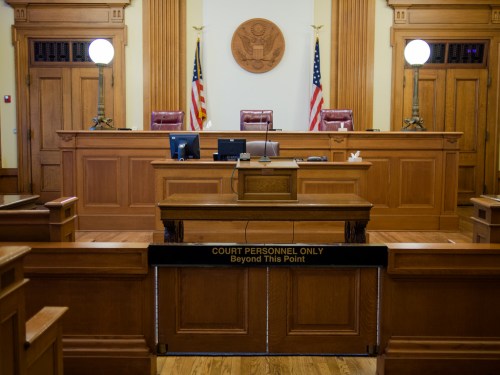
The Forbidden Word At Trial And Why You Should Care

We don’t know what we don’t know.

It’s just in our nature to not look deep into circumstances in which we don’t find ourselves.  However, whether you are ever involved in a lawsuit – as a party or a juror – you should know one of the most basic tenants that all lawyers know, but jurors most often do not.

If you’ve ever watched a criminal trial on television, maybe the O.J. Simpson trial or the more recent Casey Anthony trial, you knew more than the jury did during the trial.

That is because the judge, in both criminal and civil trials, acts as a gatekeeper to limit the issues to the material ones to help the jury reach a verdict and also to limit the length of the trial.

Just before trial starts, what attorneys call “motions in liminie” are filed by both sides in an attempt to persuade the judge to use his or her discretion and keep something out of trial or let something come in as evidence.

To go to all that trouble to research, brief, and argue the issues, you can bet that one side finds the subject of any such motion harmful to their case, and the other side would love for the jury to hear all about it.

It’s a balancing test.  If the judge finds the issue or fact to be more harmful to a party than helpful to the jury, then the judge will exclude that evidence at trial, and the jury will never hear about it – at least not until the trial is over.

However, the issue of insurance coverage is automatically excluded from any civil trial, with rare exceptions, which will be a topic for another day.  In the law, like in most things, there are always exceptions.

For the most part, however, just the utterance of the word “insurance” could lead to a mistrial.  At the least, it will lead to a motion for a mistrial from the Defendant’s lawyers.

The reason behind this rule is that lawmakers (or insurance lobbyists with their ears) are concerned that if a jury knows that insurance is available, and not one penny will actually come from the pocket of the person or company named as a Defendant in a case, they will always side with the Plaintiff and award boatloads of money to the Plaintiff.

It is true that whether insurance is available is not what the jury is supposed to decide at trial.  Jurors are simply supposed to determine the facts and apply those facts to the law the judge gives them.  If they find the Defendant is at fault, then they are tasked with determining an award for the Plaintiff, as they see fit.

However, by silencing any mention of insurance at trial, the rule formed to protect multi-billion dollar insurance companies from large, automatic verdicts may be doing more harm to Plaintiffs than it would to the insurance companies were the jury to hear that the Defendant has insurance to cover an award.  Many times, the Plaintiff also has insurance to cover an award, but this post is not intended to reach that deep into insurance law.

Jurors often have never been involved in a legal dispute.  They may have some life experience filing an insurance claim and having it resolved rather easily, and without having to involve attorneys.

In speaking to past jurors and prospective jurors, they often do not understand why a Plaintiff would have to file suit, and sometimes they have wildly wrong assumptions for why a Plaintiff ends up in trial against a person.

Recently, I heard a person during jury selection say that people sue when they want more money than the insurance policy affords.  Others echoed similar preconceived, incorrect notions.  In talking to a highly-educated friend about the frustration Plaintiff’s attorneys feel because they are banned from explaining that is not so, she was surprised to hear that the misunderstanding would not be addressed during the trial.

Because the word “insurance” is forbidden at trial, the Plaintiff’s attorneys cannot say anything to correct any wrong ideas.  They cannot explain why the Plaintiff had to take the case to trial to recover any insurance at all.

Additionally, the judge cannot answer valid questions about insurance that the jury may ask while deliberating.  Such questions, which are sent on written notes to the judge from the jury room, tell us lawyers that, at the very least, while in that room and in that moment, the jurors know they are not getting the whole story.

From the Plaintiff’s viewpoint, the jurors crave a deeper look into the circumstances surrounding insurance coverage.  However, their questions are met with silence.

The jurors have all the power without all the knowledge, and they have to make a decision with the facts they are provided and without the ones withheld.

They simply do not know what they do not know.

Injury Law Only Blog

I am an attorney fortunate enough to be a part of the Spiva Law Group team.  I started this blog to share some of the stories of our amazing clients — past and present —  and their incredible strength as they let us tag along in their pursuit of justice.

Follow injurylawonly.wordpress.com for weekly David vs. Goliath stories from the trenches and all things Plaintiff.

Thank you!

Do You Want To Be A Plaintiff?

I’m sitting in my office, writing an introduction to a response brief once again because the Defendants filed yet another senseless motion.  To a non-attorney, it’s harassment.  To this attorney, that is exactly what it is, and we should call it that.  This is a case where our client was turned away by other attorneys because a series of battles to get any sort of justice from any one of the many bad actors was clearly in store.

Fortunately, he heard about us, and we agreed without hesitation to take the case on.  He’s paralyzed.  He did nothing wrong.  Still, years later, I’m writing another intro to explain to the court why we are asking once again for a ruling in our favor.  We don’t quit.  We don’t back down.  But, we do get frustrated with the system.

Of course, I don’t like seeing my clients jerked around.  But to them, it’s much more than that.  It’s years of being denied.  It’s years of no or inadequate medical care.  It’s years of no income because the injuries prevent the Plaintiff from working.  So, I get over myself, and start typing.

The introduction to a legal brief is sometimes the only place you can strongly appeal to a judge from an emotional standpoint.  That is why it had me thinking across many cases and many Plaintiffs we have represented who also were seriously or catastrophically injured or worse.

Just after I had graduated law school, one of my mentors said often to me and to anyone that would listen, “there is the law, and then there is what is right.  They are not always one and the same.”  That too is why we take chances and fight for clients who don’t have the law solidly in their favor.  We fight the constant battles because we know it is the right thing to do.

Perhaps you have heard about one such case that was very much in public view in Savannah.  A young mother of two, Shanta Greene was catastrophically injured when on July 2, 2010, a large limb of a decaying, centuries-old Live Oak Tree literally fell from the sky above.  The massive limb brought to a halt the pickup truck in which she was riding, and it impaled her, as it crashed through the windshield and into the cab of the truck.  Most have heard of the incident and of the trial that rocked Savannah in 2013, but most likely have no idea of the gravity of the injuries she sustained.  Shanta’s own Life Care Planner made her leave the courtroom when she testified at trial, because she did not want to damage Shanta’s incredible strength and drive to overcome as many odds and challenges as she could.

We hear often about “ambulance chasers,” how we are a “litigious society,” how “insurance rates go up because of lawsuits,” and so on.  People following Shanta’s trial against the City of Savannah heard that the jury delivered the largest verdict against the City ever.  What we don’t hear about so much is that Shanta had to fight for three years to have her day in court.  She was denied completely for three years.  She lived in poverty and had to sleep sitting up in her living room chair for three years because her bed was not an option due to the constant, debilitating pain.  I could go on and on with more examples, but you get the idea.  There was no doubt that she was catastrophically injured.  There was no doubt that she did nothing wrong to cause her injuries.  Still, attorneys turned her away before she heard of us because the legal footing regarding both liability and suing the sovereign City was not rock solid.

Even those Plaintiffs with the law solidly in support of their cases are not always treated by the Defendants and their attorneys any differently.  The tactics are usually the same:  Deny, deny, deny.  Delay, delay, delay.  Wear the Plaintiff and their lawyers out with constant and expensive work and uncertainty.  Make the Plaintiff say “uncle” and settle for less just to have it all over.

What many did not hear about Shanta’s case is that even after the verdict, the battles did not end.  The City appealed, and then, finally, after more fighting, the case settled.  It took Shanta three years to have a jury of her peers tell her that she deserved justice that the City denied her.  Three years later, in early 2017, she is facing more risky surgeries, any one of which could lead to complications and more surgeries down the road.  Surgeries have been a constant staple in Shanta’s life since that day in July of 2010.  Essentially, even when it’s over, it’s not over.

This is the plight of the Plaintiff that got the largest verdict in history against the City of Savannah: twelve million dollars.  She was and is now in the best position.

Do you want to be a Plaintiff?